

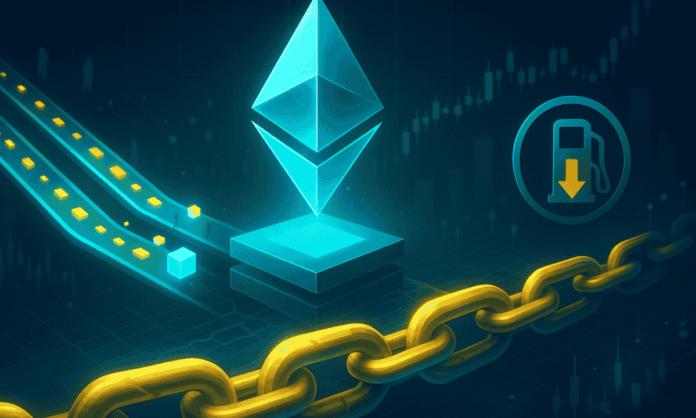
Ethereum users are breathing a sigh of relief after the network’s latest Layer-2 scaling upgrade slashed average transaction fees by roughly 40%. The update, which went live earlier this week, is already reshaping user behavior across the DeFi, NFT, and gaming ecosystems. For developers and traders alike, the cost savings could mark the beginning of a more active and inclusive phase for the Ethereum economy.
A Long-Awaited Breakthrough in Affordability
High gas fees have been Ethereum’s most persistent pain point, often pricing out smaller participants and pushing activity to alternative chains. While the Merge and earlier Layer-2 rollups provided incremental relief, this latest upgrade represents the most significant reduction in transaction costs since the network’s inception.
The update optimizes data compression for rollup transactions, allowing Layer-2s to submit more compact proofs to Ethereum’s mainnet. As a result, the cost of settling transactions from networks like Optimism, Arbitrum, and Base has dropped sharply. This reduction trickles down to end-users, who now pay substantially less for activities like token swaps, NFT minting, and gaming interactions.
Immediate Market Impact
On-chain analytics show a spike in Layer-2 usage since the upgrade. Daily active addresses on major rollups have risen by over 20%, and decentralized exchanges are reporting an uptick in smaller, more frequent trades. The NFT sector has also seen renewed activity, with marketplaces noting higher minting volumes for lower-priced collections that previously suffered from fee-to-value imbalances.
For DeFi protocols, the drop in transaction costs is particularly significant. Yield farmers can now adjust positions more frequently without losing profits to gas, while lending and borrowing platforms are seeing a broader range of collateralized positions due to lower overhead costs.
Developer Optimism and Ecosystem Expansion
Lower fees are also boosting developer sentiment. Smaller teams that once hesitated to deploy on Ethereum due to user-cost concerns are now reconsidering. This could spark a fresh wave of dApp launches in the coming quarters, particularly in emerging categories like decentralized social media, on-chain AI marketplaces, and micro-payment-driven gaming platforms.
Several Layer-2 teams have already announced plans to pass on the savings through fee reductions or loyalty programs. Some are introducing “gasless” transactions for specific actions, subsidized by protocol treasuries or partner sponsorships, to attract and retain new users.
Competitive Pressure on Alternative Chains
Ethereum’s fee relief also has implications for competing ecosystems. Over the past few years, networks like Solana, Avalanche, and Binance Smart Chain have gained market share by offering faster and cheaper transactions. If Ethereum can sustain lower fees while maintaining its security and decentralization, it could reclaim some of that lost activity.
However, analysts caution that the upgrade does not eliminate competition entirely. Alternative chains still have advantages in niche areas, such as ultra-low latency for gaming or native compatibility with certain enterprise solutions. The new dynamic could instead foster more cross-chain collaboration, with Ethereum serving as the settlement layer for multi-chain applications.
A Boost for Layer-2 Token Economies
The upgrade’s benefits are not limited to Ethereum itself. Native tokens of leading Layer-2 networks have rallied in the days since the fee drop, as investors anticipate higher transaction volumes and greater adoption. Increased activity translates to more protocol revenue, which in some cases is shared with token holders or used for buybacks and burns.
If the momentum continues, analysts expect these tokens could outperform the broader market in the short to medium term. Liquidity providers are already expanding positions on Layer-2-based DEXs, betting on sustained growth in trading volume.
Remaining Challenges and Next Steps
Despite the positive shift, Ethereum’s scaling journey is far from over. As adoption increases, transaction demand will eventually rise again, potentially pushing fees higher unless further optimizations are implemented.
Developers are already working on future upgrades to reduce costs further, including full implementation of EIP-4844 (proto-danksharding), which will introduce dedicated “blob” storage for rollup data, and eventual full sharding of the Ethereum network.
In the meantime, user education remains critical. While fees have dropped, navigating Layer-2 solutions can still be confusing for newcomers. Wallet providers, exchanges, and dApps will need to make bridging and switching between networks seamless if Ethereum wants to fully capitalize on the upgrade’s potential.
The Bottom Line
Ethereum’s latest Layer-2 upgrade has delivered a meaningful reduction in transaction fees, revitalizing activity across DeFi, NFTs, and gaming. By making the network more affordable without sacrificing security, Ethereum has strengthened its position as the backbone of Web3.
If developers and protocols can build on this momentum, the lower-cost environment could drive a new wave of innovation and adoption — one that not only benefits Ethereum but also redefines the competitive landscape for blockchain ecosystems in 2025 and beyond.