

The crypto world has no shortage of bold claims. Every other week, some chain insists it’s “the future of finance,” “the Ethereum killer,” or the silver bullet for blockchain’s growing pains. Most fade into the noise. But this week, Solana didn’t just talk—it put numbers on the table. Big ones.
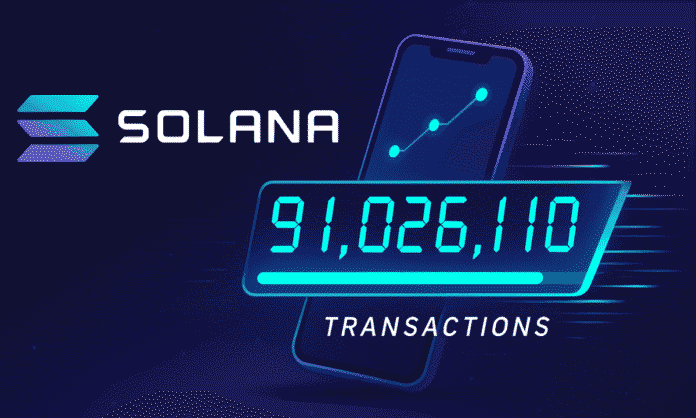
According to a new performance report, Solana has shattered transaction speed records, clocking in at over 91 million transactions per day—a throughput level most chains can’t even dream about. To put it bluntly: Solana is now processing transactions at a rate faster than Visa on its best day.
And it’s not theoretical. These aren’t lab-simulated stress tests with convenient caveats. The network is doing this in real time, in the wild, under genuine usage conditions.
Why Speed Matters in Blockchain
For years, blockchain has carried a paradox. The technology promises openness and decentralization, yet it often stumbles under its own weight. Ethereum, for all its innovation, has been plagued by congestion and sky-high gas fees. Bitcoin remains secure and reliable but can be painfully slow.
That’s where Solana has always staked its bet: speed. From its inception, the chain has touted “web-speed blockchain”—a pitch that sounded more like marketing fluff in 2020. Today, it looks less like fluff and more like foresight.
Imagine moving digitcounter oral dollars with the same immediacy as tapping your phone at a café counter, or a DeFi protocol executing complex trades without lag. That’s the kind of utility mainstream adoption quietly demands. And Solana, for now, seems closest to delivering it.
The Trade-Offs That Won’t Go Away
But—because in crypto there’s always a “but”—speed doesn’t come free. Solana’s critics have long argued that its architecture sacrifices some degree of decentralization to achieve these performance metrics. More transactions per second means more demanding hardware requirements, which narrows the pool of people who can run validators.
The chain has also suffered high-profile outages in the past, the kind that make institutional investors hesitate. When you’re talking about a financial backbone, even a few hours of downtime is a dealbreaker.
Yet, for all the hand-wringing, Solana’s developer ecosystem hasn’t just survived—it’s thrived. NFT marketplaces, DeFi projects, and even gaming platforms are increasingly choosing Solana not because it’s trendy, but because it simply works faster.
Breaking Beyond the Niche
The numbers raise a bigger question: is blockchain finally ready to handle mainstream traffic? For years, the industry has dreamed about a global payments system that could rival Visa, Mastercard, or PayPal.
Solana’s performance is a step toward that vision. At peak capacity, its network can theoretically process more than 65,000 transactions per second. In practice, the recent numbers show it’s not far off. Compare that to Ethereum’s ~15 TPS or Bitcoin’s ~7, and you begin to see why developers are paying attention.
It also matters for non-financial use cases. Think gaming, social apps, or microtransactions at scale. If you’ve ever tried to play a blockchain game that required waiting for every on-chain action, you know why speed isn’t just a “nice to have”—it’s the whole ballgame.
The Bigger Picture
The achievement puts Solana in rare company. It’s no longer just competing in the crypto echo chamber; it’s nudging against the benchmarks of traditional finance. Whether it can hold that pace—and stay online without hiccups—will define whether this record-breaking moment is a milestone or a footnote.
For now, Solana has done what few chains have managed: silence its critics, at least temporarily, by delivering undeniable results. And in an industry drowning in hype, that’s no small feat.